How faint does the FirstScope actually see
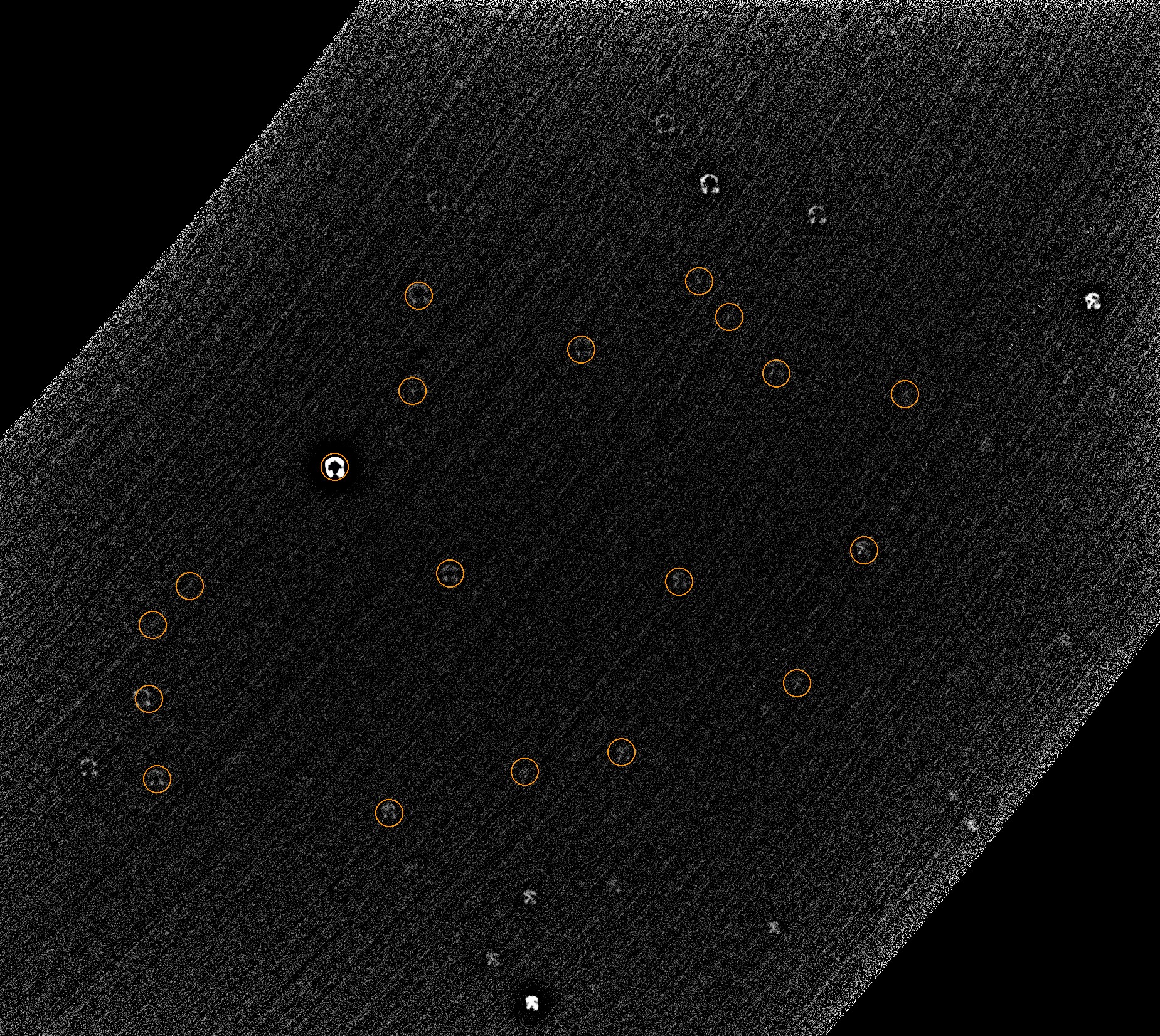
A 76 mm scope with no tracking, stacking half an hour of three-second frames, reaches about 12th magnitude. The interesting part is not the number but how you get it without a star catalogue: count how many stars you can see in a known patch of sky, and look up how many stars there are supposed to be. The sky itself is the calibration.
Counting what is there
The de-rotated 30-minute stack was matched-filtered at the PSF scale and everything above 5 sigma was counted, over two regions of the canvas that differ five-fold in area:
| region | area | sources | density |
|---|---|---|---|
| full depth, 600 frames | 0.063 deg² | 3 | 47 /deg² |
| half depth and up, ~442 frames | 0.321 deg² | 19 | 59 /deg² |
Standard cumulative star counts — about 8 stars per square degree brighter than 10th magnitude, 55 brighter than 12th, 135 brighter than 13th — put a density of 59 per square degree at V ≈ 12.1.
The correction that mattered
The first pass counted 35 sources in the larger region, not 19, and gave V ≈ 12.8. That was wrong, and the way it was wrong is worth recording.
The detector was finding 35 separate blobs, but their median nearest-neighbour separation was 15.5 pixels. For 19 stars scattered at random across that region the nearest neighbour should sit around 120 pixels. Stars do not clump at 30 arcsec.
Looking at the pixels settles it: each source is a ring, not a dot — the annulus of a defocused Newtonian with a central obstruction, about 20 pixels across, and the detector was breaking each ring into two to four arcs and counting them separately. Merging detections within 25 pixels gives 19 sources, and the estimate drops by 0.7 magnitudes.
The clue was in the cross-check all along. An independent estimate from astro-capture's polar strip — 269 sources over 9.7 square degrees at a median depth of 114 frames — gives V ≈ 11.3, which scaled to 600 frames predicts 12.2. Against the over-counted 12.8 that looked like a 0.6 magnitude disagreement to be explained away. Against the corrected 12.1 the two methods agree to a tenth of a magnitude.
What it implies elsewhere
Stacking gains go as the square root of the number of frames, which the 88-percent-of-ideal result on this night supports, so one number gives the others:
| single 3 s frame | V ≈ 8.6 |
| stars used for the PSF fit (130–270 sigma) | V ≈ 7.8 to 8.5 |
| whole night at today's pointing, 27x | V ≈ 12.2 |
| pole-centred ceiling, 106x | V ≈ 13.7 |
That last line is the case for walking the mount onto the pole. The difference between today's 4.32 degrees and a field centred on the pole is about 1.5 magnitudes, for no extra hardware and no longer night.
How much to trust it
The dominant uncertainty is not the counting. Poisson error on 19 sources is about 0.25 magnitudes; the star-count model and the unfiltered response are worth more than that.
- The band is not V. The sensor is panchromatic, so red stars are
favoured and V is a stand-in. A few tenths.
- Galactic latitude, with a direction. The field is near Polaris, about
27 degrees above the galactic plane, where counts run below the all-sky average used here. Fewer stars available per magnitude means you must go deeper to find 59 of them, so the true limit is if anything slightly fainter.
- 5 sigma is not completeness. Turnover begins half a magnitude to a
magnitude brighter; this is nearer a 50 percent completeness point than a hard floor.
- The area depends on an unmeasured plate scale. Density is sources per
square degree, and the square degrees come from the FirstScope's theoretical 1.925 arcsec per binned pixel. A 10 percent error there moves the area 21 percent and the answer about 0.2 magnitudes.
That last one has a fix, and it is the same fix that turned astrocam's sky brightness from a map reading into a measurement: plate-solve a stack and cross-match it to Gaia. See the astrocam plate solve for what that produced on the other camera — a measured scale, a real field of view, and a photometric zeropoint. On the FirstScope it would replace this entire estimate with a measured limit.