FirstScope
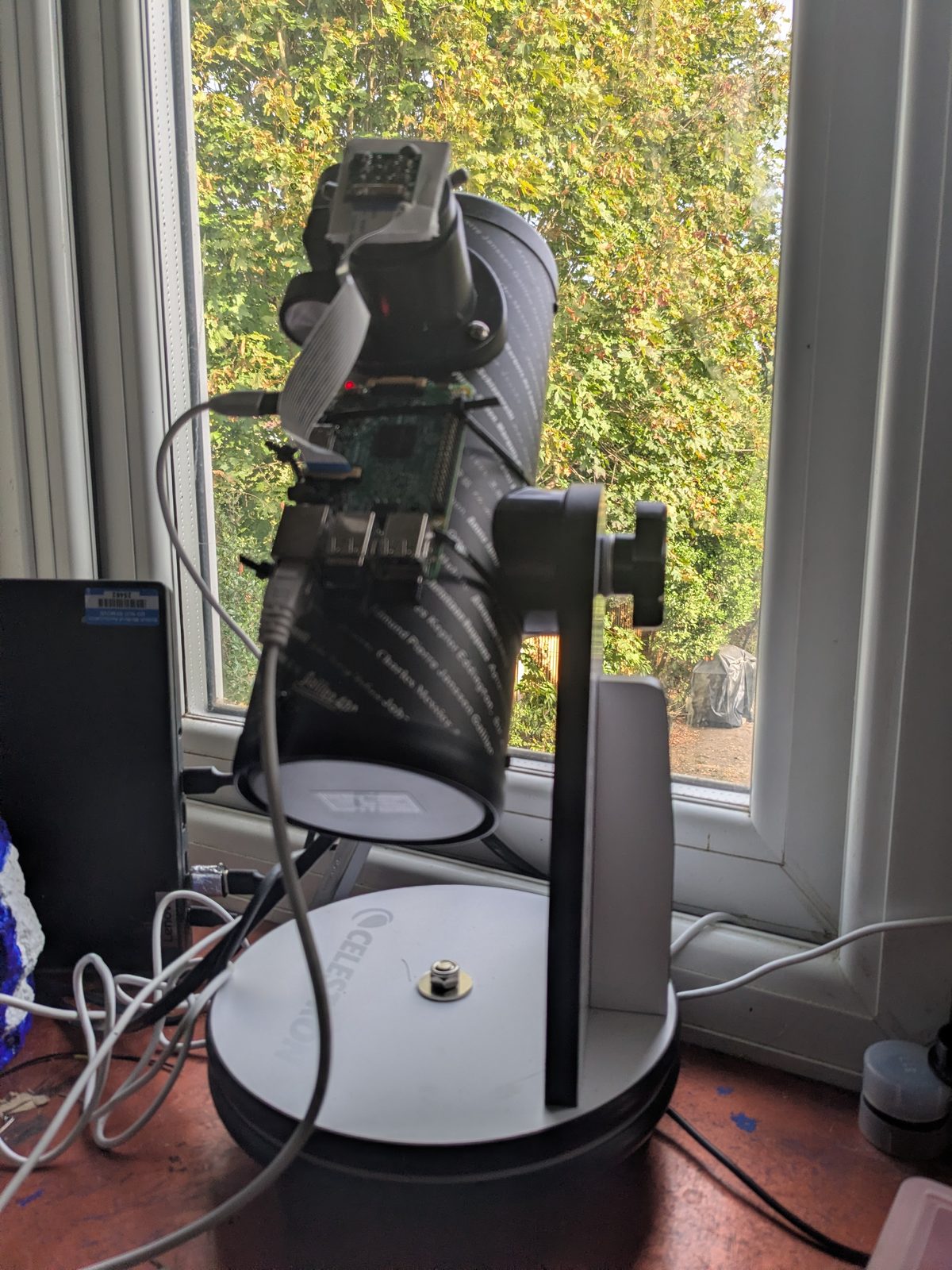
The Celestron FirstScope model 21024-IYA is a 76mm (3") Newtonian. The light comes from the sky (obviously) through the window, which I must get round to cleaning, and into the tube at the top (obviously). It travels the tube, dodging a little mirror (which we will come back to) and hits the mirror at the bottom. It's made of glass, but with the metal at the front and is curved like part of the inside of a sphere, which would be twice the size of a beach ball, and is 76mm in diameter. The light reflects, travels up the tube and hits the mirror which it scraped past on the way down and is reflected at 90 degrees to the eyepiece where normal people use an eyepiece to focus it. The distance from the bottom mirror to the angled one is about 300mm, or a foot. That's 1 billionth of a light second. I use it to look at Polaris which is 450 light years away!
I replaced the eyepiece with a Raspberry Pi camera v1 which I took the lens off. One day I might splash out £50 on a Raspberry Pi High Quality camera, but for now the v1 camera I already had will do fine. The camera takes a photo for 3 seconds every 3 seconds and whilst it's taking the next one, sends it over the network (the white cable) to be stored and processed. The position and orientation of the camera are crucial - I really need to find Polaris to work out what I'm looking at, the window looks out North, towards London and Heathrow airport 9 miles away. Polaris has the advantage of not moving much as the earth rotates and I like the challenge of resolving the fainter companion star which orbits around it. The next step is to mount lasers on the scope and mark on the walls and table where the camera is pointed. Focus is crucial and I'll have to either move the camera and focus using the moon or get lucky, or think of something cunning.
First quest
Resolve Polaris B, the faint companion to the pole star, first seen by William Herschel in 1779. A and B are 18 arc seconds apart. The naked eye can at best separate things about an arc minute apart, 3 times too big, so no chance there, but a 76mm mirror can in theory separate two stars about 2 arc seconds apart, 10 times closer than we need. Wow! It's the width of the mirror that decides this, not the focal length. The focal length decides how big things come out on the camera, and here 18 arc seconds is about 10 pixels.
Those are "binned" pixels. The camera has a colour sensor, so each pixel is really 4 cells (red, two greens and a blue) added together, and at a pinch I could use the cells separately.
The hard part is brightness. B is about 500 times fainter than A. Each cell gives a 10 bit number, 0 to 1023, and some of that is lost to the pedestal (the camera adds a bit so that black is not zero, because you can't risk a number being negative because of noise and being lost), so in one 3 second photo B is barely there next to A. The answer is software: add hundreds of photos together and B builds up out of the noise. Luckily Polaris hardly moves as the earth rotates, so I don't need to track it or do much derotating before adding them up.
- Separation of A and B
- 18″
- Resolving limit of 76 mm
- 2″
- So the pair is
- 10× wider than the limit
- At 2″ per binned pixel
- 10 pixels apart
- B is fainter by
- 500 times
- B's magnitude
- It's fairly dim at mag 8.7, but a 30 minute stack (average) should achieve 12.1 mag
- Stack depth
- 10 bits per picture, but averaging 600 frames gives more than 19 bits
Focusing is difficult: Celestron have put some effort into the mechanism and are makers of some very fine instruments, so this is quite useable, however focusing using images relayed from the camera to a laptop, in the dark, is more difficult. The geometry of the scope, f/4, is the focal length divided by the width of the mirror (300mm / 76mm, near enough). A small number like that means a short, fat cone of light, which is good for brightness but very fussy about focus. At f/4 the depth of focus is about 17 microns, so a tenth of a millimetre out spreads Polaris A into a disc 17″ across, which is the whole gap between A and B.
A potential cunning idea, as well as the lasers so I can move and replace the scope where it was consistently, is to move the camera up and down 10 microns or so, very much the kind of movement heating metal tubes 50mm long or so achieves with 10 degrees C. This can be done with the Pi and is a really cool challenge. Use 3 tubes and the sensor tilt can be adjusted too so the focus is even over the whole sensor.
Very long observations can be made. It's all automatic, so a month, or even a year. It will be fascinating to see what can be detected. The effect of cold weather - I might need to temperature control the room the scope is in, or put it in a box. The effect of cold on the atmosphere. Polaris A is a Cepheid variable and detecting that would be awesome but very difficult.
Second quest
Find NGC 3172, also known as Polarissima Borealis, the closest galaxy to the North Celestial Pole. It's a faint spiral of about 14th magnitude, which is way dim, 6 times fainter than the 12.1 a 30 minute stack should reach, and it's a smudge not a point, so its light is spread out too. Against a Surbiton sky of 18.1 mag/arcsec² that's going to take a lot of pictures, probably tens of hours. The good news is that, like Polaris, it hardly moves as the earth rotates (it's about 1 degree from the pole) so the rig can just sit there and collect, night after night.
It's not in the same field as Polaris, they are about 1.5 degrees apart, so I'll have to move the scope, which is where the lasers come in. First with the v1 camera I already have, to see how far it gets, then with the Raspberry Pi High Quality camera, which has 12 bits instead of 10, a field of 2.3 moons (1.2 degrees), and is maybe twice as sensitive, with very slightly less resolution, still about 1 arc second per pixel. Seeing the same galaxy come out sooner and cleaner will show what the £50 actually bought. I'll probably start collecting raw unbinned images about that time, maybe stacking 20 at a time on the Pi to reduce storage size.
Targets near the pole
With the lasers I can point the scope at things of interest near the pole, and there are quite a few. The scope doesn't move but the sky turns about the pole, so every star circles it and a target only crosses the field if the field is the same distance from the pole, within about half a field. So the distance picks the pointing and the time of night picks where round the pole to put it. The closer to the pole the longer a target stays. The times are for the v1 camera's 0.7 degree field; the HQ camera's would be about 1.7 times longer.
| Target | From the pole | Time in the field | |
|---|---|---|---|
| Polaris and B | 0.6° | 4 hours | The first quest. |
| λ UMi | 1.0° | 2.7 hours | A 6th magnitude star, handy for checking the pointing. |
| NGC 3172 | 1.1° | 2.5 hours | The second quest. The closest galaxy to the pole, about 14th magnitude. |
| The Engagement Ring | around Polaris | A ring of 8th and 9th magnitude stars with Polaris as the diamond. | |
| 24 UMi | 3.1° | 52 minutes | A 6th magnitude star, right on the distance of the current pointing. |
| δ UMi (Yildun) | 3.4° | 47 minutes | A 4th magnitude star, bright enough to aim by. |
| 2 UMi | 3.6° | 44 minutes | A 4th magnitude star, as bright as Yildun. |
| NGC 1544 | 3.7° | 43 minutes | A galaxy, about 13th magnitude. |
| NGC 2276 and NGC 2300 | 4.3° | 37 minutes | A pair of galaxies, about 11th magnitude, a harder cousin of NGC 3172. |
| NGC 188 | 4.6° | 35 minutes | One of the oldest open clusters known, 8th magnitude and about 15 arc minutes across, so it fits the field. |
| NGC 2268 | 5.7° | 28 minutes | A galaxy, about 12th magnitude. |
| NGC 6251 | 7.5° | 21 minutes | A galaxy with a famous radio jet, about 13th to 14th magnitude. Plain to look at, but a good story. |
| IC 3568 (the Lemon Slice) | 7.6° | 21 minutes | A small bright planetary nebula, about 11.6 magnitude and 18 arc seconds across, so around 9 pixels. |
| ε UMi | 8.0° | 20 minutes | A 4th magnitude star. |
Right now the field is about 3.1 degrees from the pole, so only 24 UMi and Yildun can cross it, and both do so in daylight (about 08:25 BST) until about December. To catch 24 UMi in the dark, the field needs to be 3.1 degrees to the left of the pole, where it crosses at about midnight. Worked out by astro-science, assuming the camera isn't rotated; the next plate solve will tell.
The instrument
- Optics
- 76 mm Newtonian, spherical primary, f/4
- Camera
- Raspberry Pi Camera v1, lens removed, the sensor sits at the focuser
- Computer
- Raspberry Pi 3, cable-tied to the tube
- Focal length
- 300 mm
- Tracking
- None, fixed mount, the sky drifts through
- Finder
- None, but 2 lasers mark where it points on the walls
- Field of view
- 0.7 × 0.5 degrees, about the width of the moon
- Plate scale
- 2 arcsec per pixel (binned 2×2)
- Frames
- 1296 × 972, already binned 2×2 at capture
- Typical sub
- 3 seconds
Modelling the mirror
The mirror is spherical, not parabolic like a proper telescope, which is cheaper to make but means the light from a star doesn't all come to the same point. I modelled it (with help from Claude). A perfect sphere this size still gives a sharp core about 2 arc seconds across, but only 10 or 15 percent of the light is in it and the rest is spread into a halo about 26 arc seconds across. B is 18 arc seconds from A, just outside that, so on paper splitting them is feasible, but only in a sweet spot of focus about 60 microns wide, and not where A looks sharpest. Seeing and the window will make it harder.
Infrared makes it worse, as the halo spreads further at longer wavelengths, and the v1 camera probably lost its IR filter with its lens. So comparing the red, green and blue channels separately should be interesting and help find the limit of the scope.
The galaxy is the opposite. It's bigger than the blur so the mirror hardly matters, what matters is the Surbiton sky and how many hours I stack. Infrared helps, it's more light, and the focus isn't critical. So the two quests pull the rig in opposite directions, which is a nice problem to have.
Timeline and milestones
- 2026-09-08First light on starcam.
- 2026-09-14Moved to xoverpi, which writes frames straight to muppet's bigstore over NFS and processes them where they land.
- 2026-09-2012,000 frames at 3 s, the night the de-rotation numbers below come from.
- 2026-09-252 lasers added, powered with 5V and a shared 470R resistor. The 2 USB plugs are joined with hot glue, the craft stick to that, then the lasers to that. They mark where the scope is pointing on the walls: the wall to the right is 101cm away, the wall to the left is 124cm.
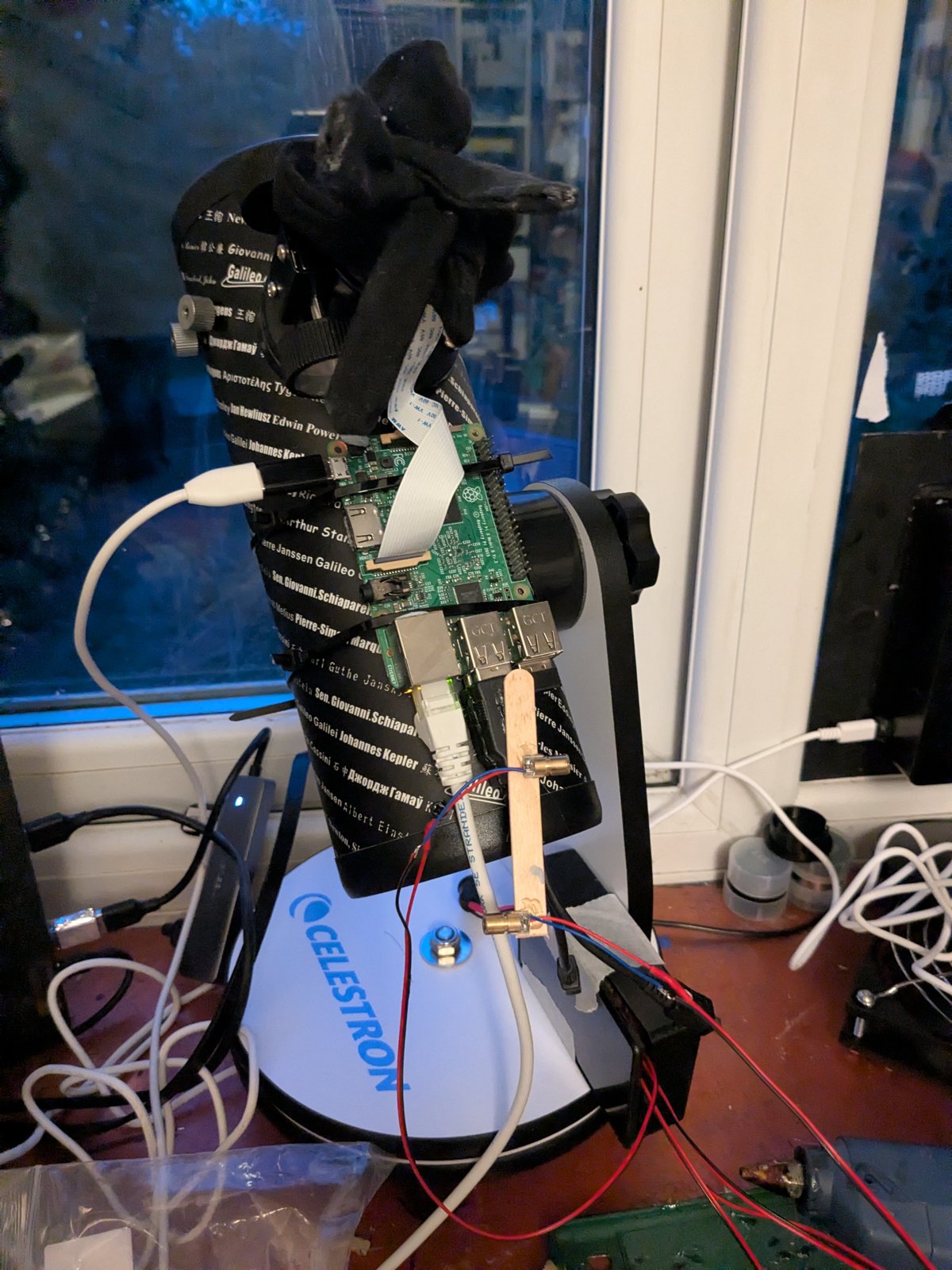
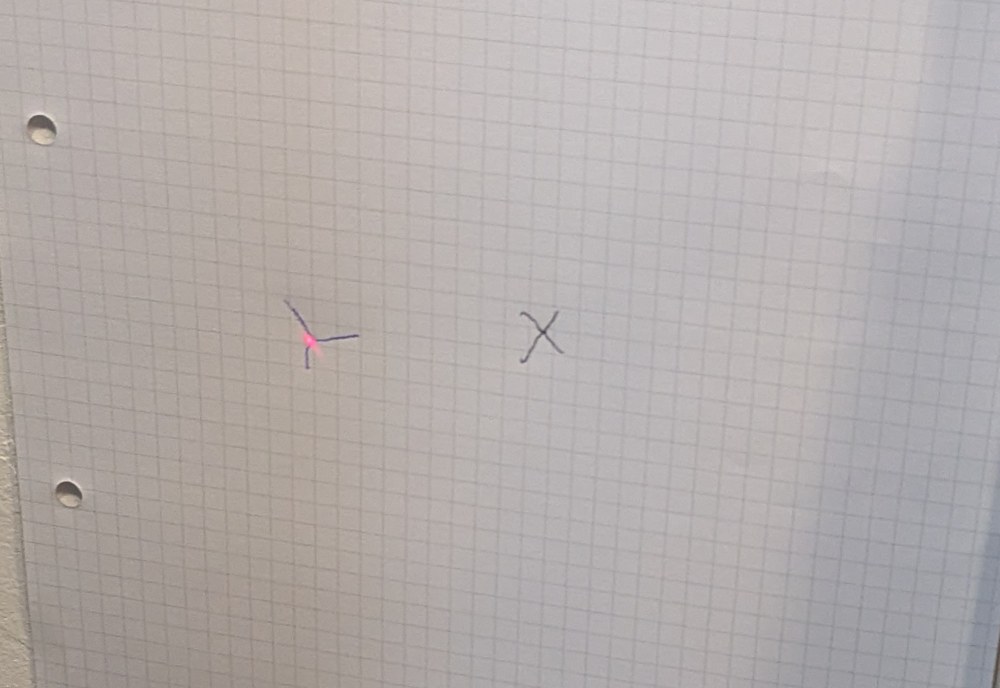
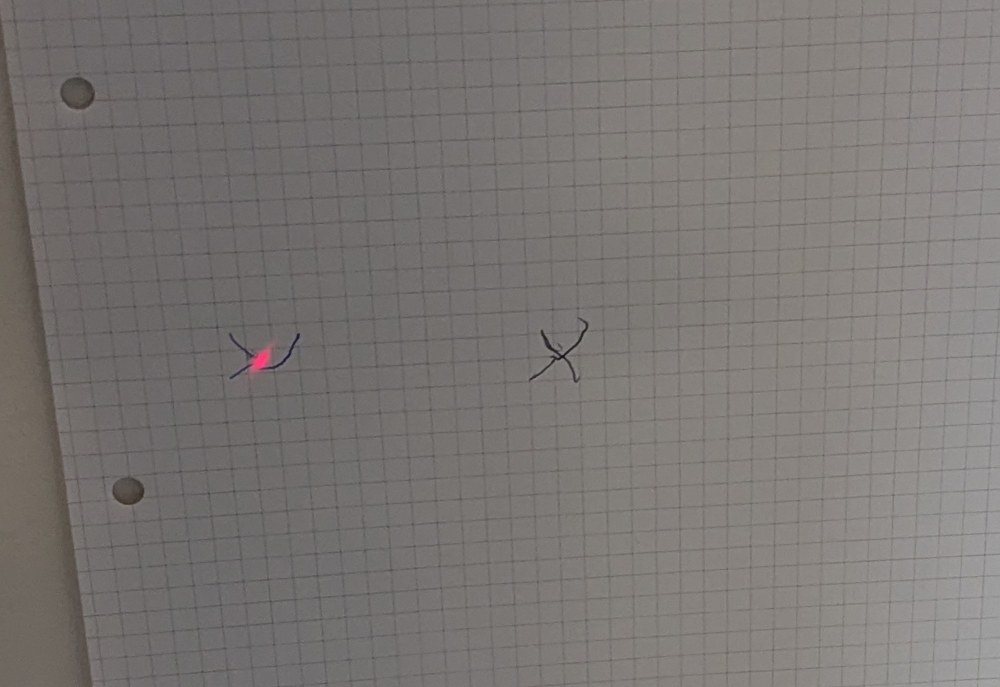
The black crosses are the last positions, when the pole was 4.3 degrees from the middle of the field, about 2.5 up and 3.5 left. Both dots have moved left, about 5cm on each wall, which works out as turning the scope about 2.7 degrees left (the two walls disagree a little, which is the scope also shifting about 1cm towards the window). Pointing 51 degrees up, that moves the field about 1.7 degrees left on the sky, so provisionally the pole is now about 2.5 up and 1.8 left, about 3 degrees away. The side lasers can't see up and down: tilting the scope just spins them about their own beams.
First results
