The camera works out which stars it is looking at
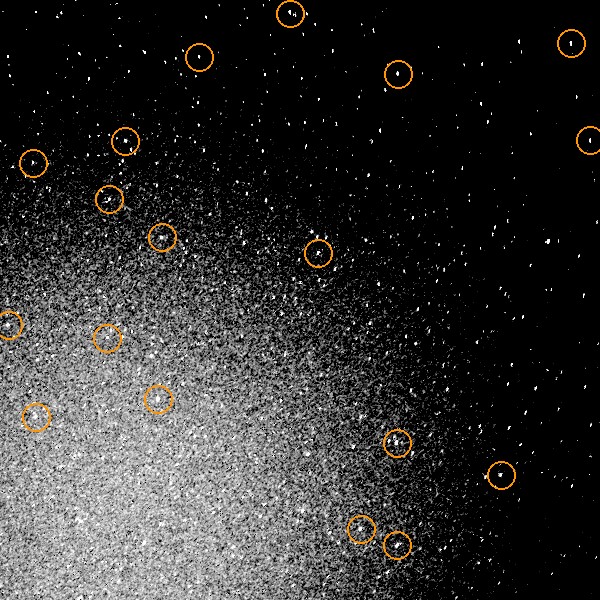
A camera that knows nothing about the sky can still be told where it is pointing and how sensitive it is, by the stars in its own picture. It works in two steps: first work out which stars these are, then look up how bright they are already known to be. Do both on one frame and the camera has calibrated itself against the sky it was photographing.
Step one: which stars are these
The green channel was pulled out of the Bayer mosaic and five 600-pixel crops were handed to solve-field, the astrometry.net solver, running against the Tycho-2 indexes on muppet. The solver knows nothing about where the camera was pointed. It looks at the pattern of bright points, searches for a matching pattern in its star catalogue, and reports where on the sky that pattern sits and at what scale.
All five crops solved. The picture above is the centre crop with the matched stars circled.
That immediately fixed something we had been carrying for months.
| was | is | |
|---|---|---|
| plate scale | 0.0190 deg/px | 0.016366 deg/px |
| (imx219 era, flagged INVALID since July) | 58.9 arcsec/px native | |
| field of view | 66 degrees (asserted) | 75.4 degrees |
The old number was 16 percent too coarse. It had been marked stale in camera.json since the imx708 swap in July, which is honest as far as it goes, but a stale number still gets used by anything that does not read the note beside it.
The spread across the five crops is 56.8 to 60.9 arcsec/px, and that spread is not error — it is about 7 percent of real radial distortion across a 75-degree field. A single scalar plate scale will always be an approximation on this lens.
Step two: how bright are they known to be
Knowing which star is which means the catalogue magnitude of each one can be read off. Every detected star was matched to Gaia DR3: 36 to 70 stars per crop, with a median astrometric residual of 37 to 43 arcsec — comfortably inside one pixel.
Their known brightness against our measured flux gives the zeropoint, the number that converts our arbitrary counts into real magnitudes.
| crop | zeropoint (Gaia G) |
|---|---|
| centre | 11.526 |
| left | 11.392 |
| top | 11.539 |
| bottom | 11.431 |
Four independent crops agreeing to about a tenth of a magnitude is the result: the calibration is a property of the camera, not an artefact of where in the frame you look.
One crop was thrown out. The right-hand crop matched only 23 stars against 36 to 70 elsewhere, with a median residual of 129 arcsec against 37 to 43 — so its solve is the odd one out and its zeropoint was not used.
Why the two steps together give the sky
The useful trick is that the sky brightness then falls out of the same frame, and the exposure time cancels:
mu_G = ZP + 2.5 * log10(4 * p^2 / S_sky)
The stars and the sky between them were recorded in the same exposure, through the same optics, on the same sensor. Anything that would scale both equally — how long the shutter was open, how sensitive the sensor is — divides out. What remains is a physical measurement of how bright our sky is, which is the companion note.
The unplanned result: black level 64, measured
Part of every astrocam frame is permanently blocked by trees and roofline. That corner sees no sky, all night, which makes it a dark reference built into every exposure.
The first percentile of all four Bayer channels is exactly 64.00. That is the sensor's electronic zero, measured. It is the value camera.json has always carried, but carried as INFERRED — the documented figure for this sensor family rather than one taken from our own hardware.
Strictly it is an upper bound, since a light leak could only raise it. Four independent channels landing on exactly the same number is hard to explain any other way.
Caveats
- Gaia G is a very broad band, and the sky's LED and sodium spectrum is
nothing like a star's. There is an unmodelled colour term of a few tenths in anything derived from this zeropoint.
- The camera points at the celestial pole: 51.4 degrees altitude, airmass
1.28. None of this is a zenith measurement.
- The photometric aperture is 6 px and loses some of the PSF wing, which
biases the zeropoint slightly low.