Transients — Meteors
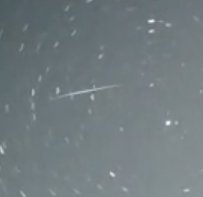
The one capture in this set that carries its own clock time, 21:17:57 on 12 August, the peak night. The star trails here are much shorter than in the other frames, so the streak stands out as several times longer than any trail around it.
Placeholder - the classification reasoning is still to be written. Length relative to the star trails is the observation worth keeping: a fixed star can only draw a track as long as the stack allows, so anything markedly longer moved independently of the sky. The recorded time is early in the evening and the crop alone does not establish how dark the sky was, nor whether that time is BST or UTC.
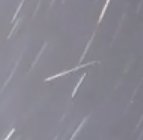
A short, bright streak against sparse star trails on the peak night of the shower. A minimal frame - a handful of trails and one track that does not belong to them.
Placeholder - the classification reasoning is still to be written. The track sits at an angle to the star trails, which is the one point that stands without knowing the capture cadence. No timestamp on the crop.
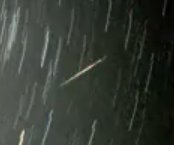
A bright, thick streak in the small hours of 11 August, tapering at both ends and set against short, closely spaced star trails. Considerably wider and brighter than anything else in the frame.
Placeholder - the classification reasoning is still to be written. Brightness and width put this well above the faint end of the collection, and the taper at both ends is what a meteor does when it brightens through its path and then extinguishes, rather than an object that entered and left the frame still lit. Timing at 02:15 BST sits in the dark hours with the Perseid radiant high.
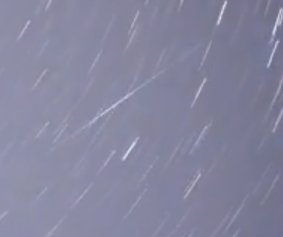
A clean diagonal streak cutting across a field of parallel star trails. The trails all run one way, set by the Earth's rotation over the length of the stack; the streak runs across them at a distinctly different angle, and is brighter and smoother along its length than any trail beside it.
Placeholder - the classification reasoning is still to be written. The non-sidereal angle is the point: everything fixed on the sky shares one direction in a trailed frame, so a track at a different angle did not come from a star. Both ends stop inside the frame. No timestamp on the crop, so no sun-altitude cross-check.
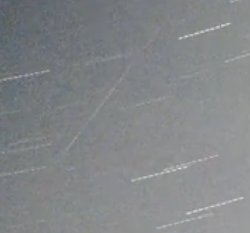
A faint diagonal track across the star trails on the night before the Perseid maximum, from the Canon. Much dimmer than the 10 August captures, and only a little brighter than the trails it crosses.
Placeholder - the classification reasoning is still to be written. The star trails are dashed because the Canon was on an interim capture cadence; the period it was in use has not been established yet, so the dashing says nothing about how long this track was present. The track angle is well off the sidereal direction, which is the one solid point. At this signal level a short satellite glint is not excluded.
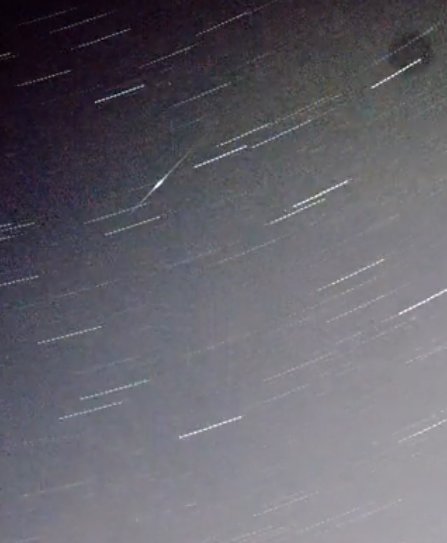
Two subs later in the same Canon sequence, a shorter streak in the upper left of the frame, noticeably brighter at its leading end and tapering away behind it. It crosses the star trails at a slant instead of following them.
Placeholder - the classification reasoning is still to be written. The star trails are dashed because the Canon was on an interim capture cadence; the period it was in use has not been established yet, so the dashing says nothing about how long this track was present. The brightness gradient along the track is the useful observation: a flare that fades is what a meteor does, where a satellite catching sunlight lights more evenly. Both ends are interior to the frame. No timestamp on this crop, so there is no sun-altitude cross-check.
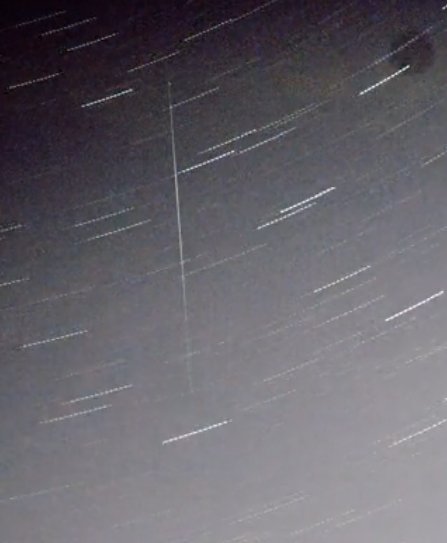
A fine, unbroken line dropping almost vertically through a field of star trails, from the Canon EOS 2000D on the evening of 10 August. It runs at a steep angle to the trails rather than along them, and both ends stop well inside the frame.
Placeholder - the classification reasoning is still to be written. The star trails are dashed because the Canon was on an interim capture cadence; the period it was in use has not been established yet, so the dashing says nothing about how long this track was present. What stands on its own here is the track angle, steeply across the sidereal direction rather than along it, and the fact that neither end touches the frame edge.