Transients
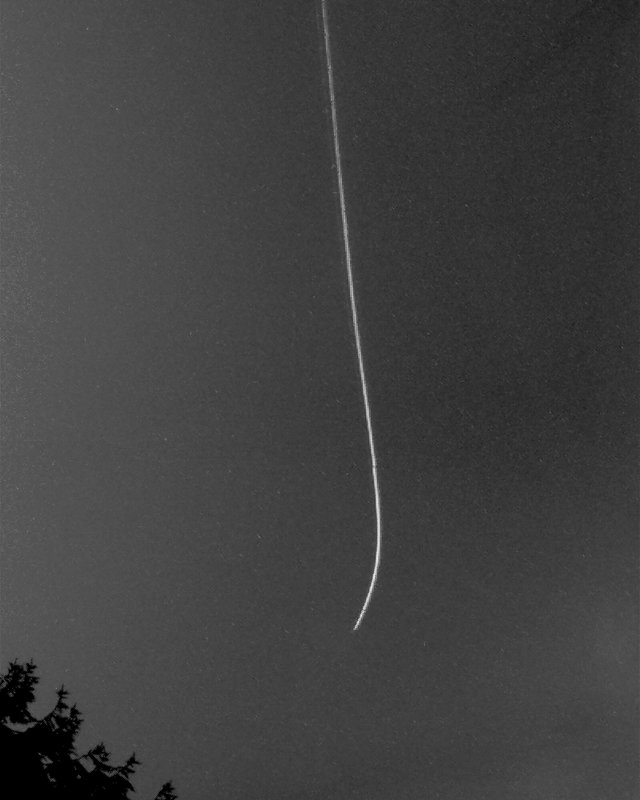
Rising out of the treeline into open sky, two consecutive 60-second exposures are combined in the image. The satellite first appears at 03:14:21 as it catches the pre-dawn sun and fades out in the next minute as the reflected light then misses us on the ground. It moves too quickly for a plane, but too slowly to be a meteor or lightning. It's also the perfect window of time at the end of the night to reflect the sun yet be against a dark sky. From its sweep rate of about 0.30 degrees per second we can calculate that it's about 500 km up in low Earth orbit.
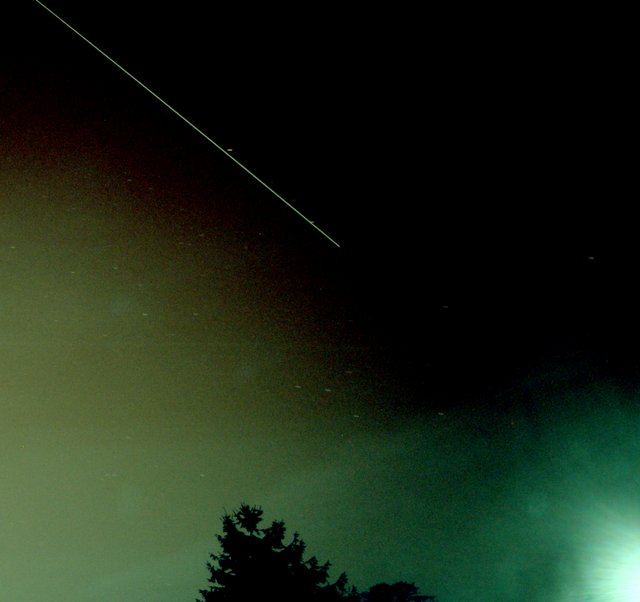
A clean, straight trail spanning 44 degrees across the sky, captured in a single 60-second exposure low in the west. It is almost certainly a satellite because the crossing happens at the right time of night when satellites in orbit catch the rising sun while the sky remains dark, and the 44-degree length shows rapid crossing. However, because it appears in only one single exposure rather than stepping across consecutive frames, it is not possible to completely rule out a much faster but unusually long meteor.
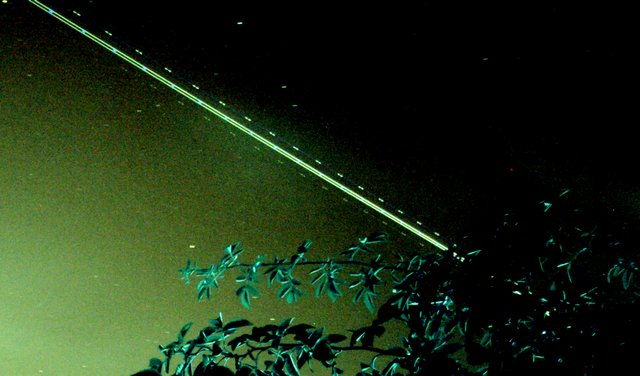
A 60-second exposure of an airliner viewed from 9 miles south of Heathrow airport. Heathrow's runways run East-West, but this aircraft is captured in a sweeping turn we calculate to be about 320 mph (280 knots). That speed and rapid turn rate point to climbing out on its departure route, rather than a slow, straight-in landing approach. The steady headlights - landing lights as they are called - leave parallel rails, while the synchronized 1-second anti-collision strobes map out the plane's true orientation in 3D space.
The gap between the tracks of the lights is 7 pixels, which at this part of the lens is 0.13 degrees — about a quarter of the width of the full Moon. An A320, for example, has a wingspan of 36 metres, which is how we worked out the speed.
The strobe flashes appear every 23 pixels along the trail, exactly once per second, at the same time, exhibiting the signature Airbus-style double-flash pattern. The lights are on the wingtips and tail top, the latter visible between the continuous landing lights. This shows us how the plane is orientated with repect to our viewpoint. The position of the lights suggests a narrow bodied jet rather than a wide one - almost certainly the ubiquitous A320.
The altitude of the plane is about 15,000 feet, 3 miles/5km so it has climbed at a good rate of 3,000 feet per minute and an angle of ascent of about 6 degrees. These are typical values for a plane climbing out of an airport.
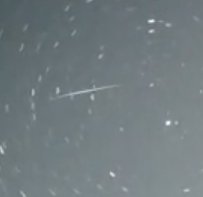
The one capture in this set that carries its own clock time, 21:17:57 on 12 August, the peak night. The star trails here are much shorter than in the other frames, so the streak stands out as several times longer than any trail around it.
Placeholder - the classification reasoning is still to be written. Length relative to the star trails is the observation worth keeping: a fixed star can only draw a track as long as the stack allows, so anything markedly longer moved independently of the sky. The recorded time is early in the evening and the crop alone does not establish how dark the sky was, nor whether that time is BST or UTC.

A short, bright streak against sparse star trails on the peak night of the shower. A minimal frame - a handful of trails and one track that does not belong to them.
Placeholder - the classification reasoning is still to be written. The track sits at an angle to the star trails, which is the one point that stands without knowing the capture cadence. No timestamp on the crop.
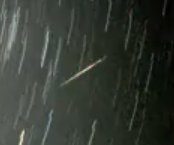
A bright, thick streak in the small hours of 11 August, tapering at both ends and set against short, closely spaced star trails. Considerably wider and brighter than anything else in the frame.
Placeholder - the classification reasoning is still to be written. Brightness and width put this well above the faint end of the collection, and the taper at both ends is what a meteor does when it brightens through its path and then extinguishes, rather than an object that entered and left the frame still lit. Timing at 02:15 BST sits in the dark hours with the Perseid radiant high.
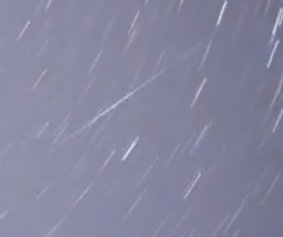
A clean diagonal streak cutting across a field of parallel star trails. The trails all run one way, set by the Earth's rotation over the length of the stack; the streak runs across them at a distinctly different angle, and is brighter and smoother along its length than any trail beside it.
Placeholder - the classification reasoning is still to be written. The non-sidereal angle is the point: everything fixed on the sky shares one direction in a trailed frame, so a track at a different angle did not come from a star. Both ends stop inside the frame. No timestamp on the crop, so no sun-altitude cross-check.
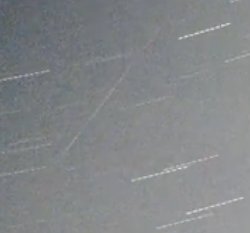
A faint diagonal track across the star trails on the night before the Perseid maximum, from the Canon. Much dimmer than the 10 August captures, and only a little brighter than the trails it crosses.
Placeholder - the classification reasoning is still to be written. The star trails are dashed because the Canon was on an interim capture cadence; the period it was in use has not been established yet, so the dashing says nothing about how long this track was present. The track angle is well off the sidereal direction, which is the one solid point. At this signal level a short satellite glint is not excluded.
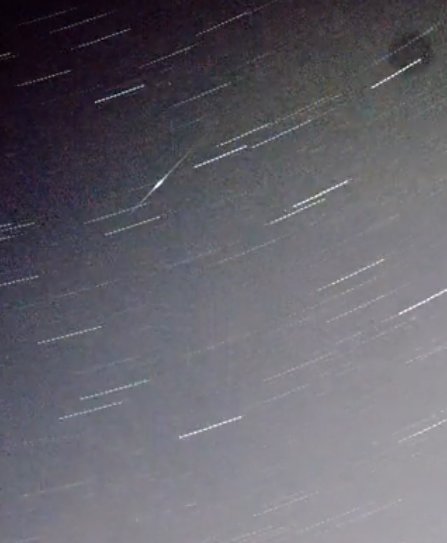
Two subs later in the same Canon sequence, a shorter streak in the upper left of the frame, noticeably brighter at its leading end and tapering away behind it. It crosses the star trails at a slant instead of following them.
Placeholder - the classification reasoning is still to be written. The star trails are dashed because the Canon was on an interim capture cadence; the period it was in use has not been established yet, so the dashing says nothing about how long this track was present. The brightness gradient along the track is the useful observation: a flare that fades is what a meteor does, where a satellite catching sunlight lights more evenly. Both ends are interior to the frame. No timestamp on this crop, so there is no sun-altitude cross-check.
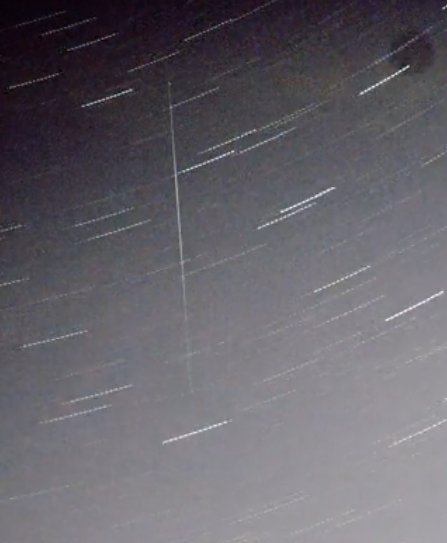
A fine, unbroken line dropping almost vertically through a field of star trails, from the Canon EOS 2000D on the evening of 10 August. It runs at a steep angle to the trails rather than along them, and both ends stop well inside the frame.
Placeholder - the classification reasoning is still to be written. The star trails are dashed because the Canon was on an interim capture cadence; the period it was in use has not been established yet, so the dashing says nothing about how long this track was present. What stands on its own here is the track angle, steeply across the sidereal direction rather than along it, and the fact that neither end touches the frame edge.