Sharpest thing resolved by each camera
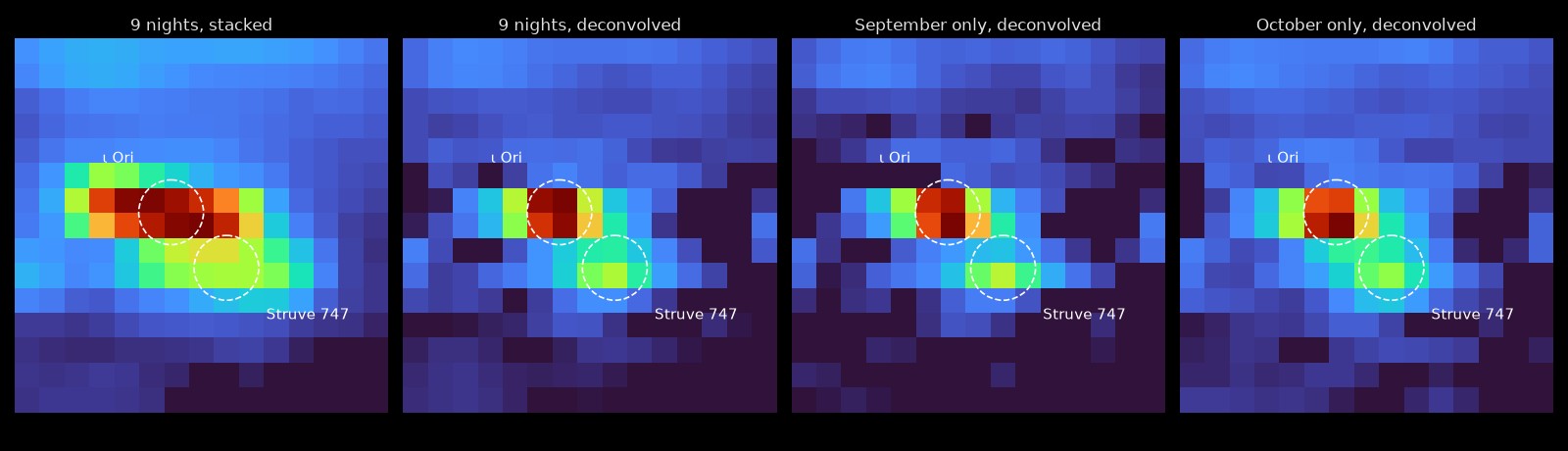
Peter: "we should have a field note for sharpest thing resolved." This is it, and it will be updated whenever the record falls.
Eclipticam v3w
Wide angle means low resolving.
The record: iota Ori and Struve 747, 8.2 arcminutes
iota Ori, the bright star at the tip of Orion's sword, and Struve 747, a fainter pair of hot young stars just south-west of it, 8.2 arcminutes apart: about a quarter of the Moon's width.
That sounds wide, and for an eye it is. For this camera it is not. Out at Orion, 45 degrees from the centre of the frame, each photosite covers about 1.3 arcminutes of sky (1.8 at the centre), and in a one-minute frame every star is smeared into a dash about 12 photosites long. The two stars are 6 photosites apart, so their dashes overlap and in the stack they are one blob with a bump on it. They only come apart when the smear is undone (the deconvolution in the Orion note): Struve 747 then stands clear of iota Ori.
Struve 747 is itself a double, 36 arcseconds apart. That is well inside one photosite, so here it counts as one star.
Why it is real and not an artefact
Undoing a smear can invent things. The usual fake is a single bright star split into two peaks along its trail. So the second peak had to pass three checks before it counts:
- It is where the catalogue says. Measured from iota Ori, the second peak is 3.09 binned pixels away (a binned pixel is a 2 x 2 RGBG set of photosites, about 2.6 arcminutes here) at 48 degrees with 0.26 of iota Ori's brightness. The catalogue, taken through the camera's measured geometry, says 3.15 binned pixels at 45 degrees with 0.24.
- Other bright stars do not do it. Eleven other bright stars in the same deconvolved image have no side peak above 5% of their own brightness. iota Ori's is 26%.
- It is there in independent data. September's four nights alone, and October's four nights alone (leaving out 9 October), each show it:
| data | separation | angle | brightness vs iota Ori |
|---|---|---|---|
| September only | 3.10 | 48 deg | 0.28 |
| October only | 2.95 | 47 deg | 0.23 |
| 9 October alone | 3.38 | 42 deg | 0.23 |
| all nine nights | 3.09 | 48 deg | 0.26 |
| catalogue | 3.15 | 45 deg | 0.24 |
Peter had already clicked on both stars when he probed the sword on 10 October, at the two positions this note confirms.
What would beat it
The trails are the limit. Undoing a smear of fixed length cannot recover fine detail along the trail, so pairs lined up east-west are harder than this one, which lies diagonally. Frames of different lengths, or a camera that tracks, would move the record. The next candidate in the sword is theta1 and theta2 Ori at the heart of M42, 1.6 arcminutes apart: five times closer, and here still one knot.