Quests! Neptune, 138 days from a dream to a dot
The dream
On 25 May 2026 at 22:13 a line went into the astro TODO list: "Neptune in November (target)". Magnitude 7.8, so well below what the eye can see from a dark site, never mind a London back garden, and the camera was a Pi with a wide lens. The budget written that night guessed about 28 hours of stacking to reach it.
A month later, on 25 June, it became the north star: "positively track Neptune in the autumn". The honest baseline written down that day was two objects identified, Polaris and the Moon.
The dot
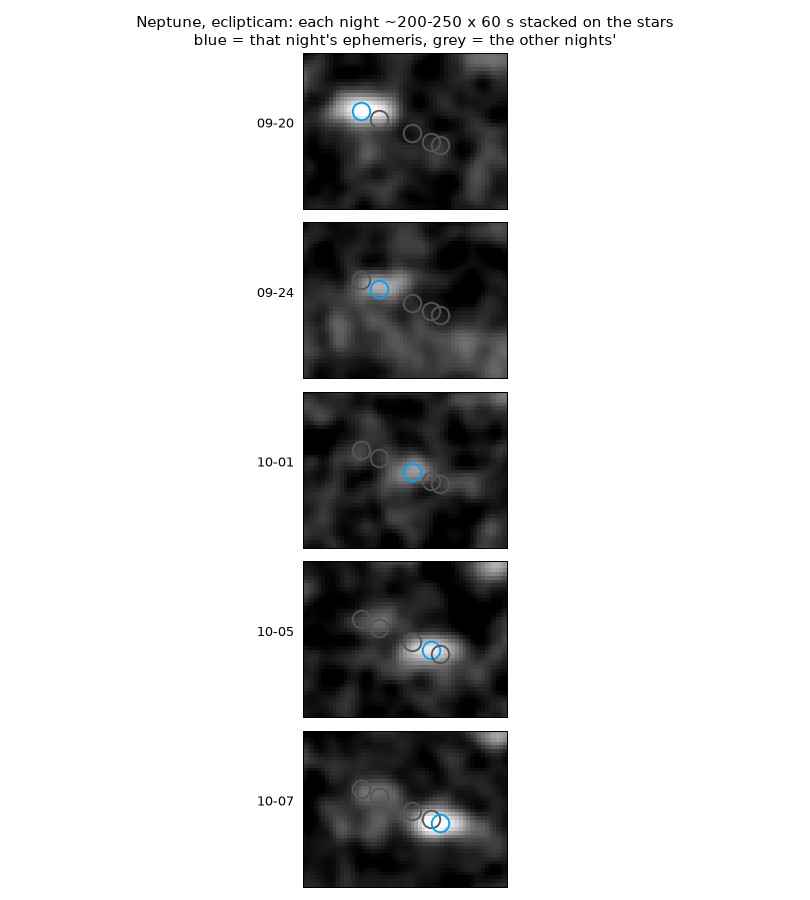
On 10 October, late in the evening, the whole-night stack of 7 October showed a faint dot at Neptune's predicted position. That was 138 days after the TODO line. The stack was 248 frames of 60 s, about 4 hours, not 28. Three things beat the guess: full-resolution raw mosaic frames, a fitted camera model good to a fraction of a photosite, and fitting every frame's pointing on the stars close to the planet.
A dot is not a planet until it moves. Four more nights came out the same way, from 20 September to 7 October. Each time the dot sat within about 1.5 arcminutes of the ephemeris (an eclipticam v3w binned pixel, 2 x 2 photosites as used here, is about 3.5 arcminutes near the centre of the frame). The places it had left were empty: in the 20 September stack, the spot Neptune would occupy on 7 October shows nothing (1.1 sigma), and the reverse holds too. No catalogue star brighter than 7.5 lies within 58 arcminutes.
By the next day the whole season was in: 47 nights stacked, Neptune found on 27 of them, and an animation of it walking west through Pisces across two months.
Saturn's rings
Saturn's rings are almost edge on and much too small to be seen with these cameras. FirstScope feasibly could just resolve them, but aiming would be difficult.
The other quests
| Quest | Set | Status |
|---|---|---|
| Neptune | 2026-05-25 | Found 10-10, 27 nights tracked, animated |
| Saturn walking through the stars | 2026-10-10 | Done 10-11: 29 nights, 08-07 to 10-09, animated against a deep star field |
| M42, the first nebula | 2026-10-10 | Done 10-10: [field note](2026-10-10-orion-m42) |
| Betelgeuse's colour | 2026-10-10 | Measured: red/green 1.74 against a white star |
| M51, the Whirlpool | 2026-07-06 | Open: wants a narrower camera |
| Algol's eclipse | 2026-07-06 | Open: autumn, needs per-night photometry |
| Polaris A/B, a rehearsal for Saturn's Titan | 2026-07-06 | Open |
| Mizar and Alcor | 2026-07-07 | Open: a calibration double, nothing blocking |
| Polaris B through half a pair of binoculars | 2026-07-09 | Open |
| See 100,000 stars, identify 10,000 | 2026-07-25 | Open: limiting magnitude now G 9 in one night |
| Starlight as a barometer (refraction) | 2026-08-14 | Open |
The next quest is Neptune again, but properly. Two Raspberry Pi HQ cameras with a 16 mm lens arrived on 9 October. With them Neptune should show at about 20 sigma in a single 5 second frame. The plan is to tilt the camera on an SG90 servo to find the ecliptic, and mount the camera in portrait orientation - maybe even tilted perpendicular to the ecliptic so we have a good chance of each planet crossing the field of view.
Kit progression and approximate commissioning dates
- starcam, Pi 1B with v1 camera, from 20 May 2026: OV5647, 5 MP (2592 x 1944), stock lens 53.5 deg wide, about 74 arcsec per photosite.
- eclipticam, Pi 5 with v3 wide camera, from 9 June: IMX708, 12 MP (4608 x 2592), about 104 x 68 deg, 1.8 arcmin per photosite at the centre falling to about 1 at the edges (3.5 and 2 per binned pixel, as used for Neptune). Full resolution from 22 June.
- 6 TB disk on muppet ("bigstore"), the archive moved onto it from 27 July.
- astrocam, Pi 4 mounted outside, from 8 June with a v2 camera: IMX219, 8 MP (3280 x 2464), about 68 arcsec per photosite. Then a v3 standard camera from 29 July: IMX708, 12 MP (4608 x 2592), 59 arcsec per photosite by plate solve, about 75 x 42 deg. A glass rain cover from 20 August.
New and to be commissioned:
- HQ camera with 16 mm f/1.4 lens, bought 9 October: IMX477, 12.3 MP (4056 x 3040), 20 arcsec per photosite, 22 x 17 deg.
- FirstScope with v1 camera, on xoverpi (Pi 3B): a Celestron 76 mm Newtonian, 300 mm at f/3.95, with the OV5647 at prime focus; 0.96 arcsec per photosite, 0.69 x 0.52 deg. Optics fitted 8 September, first frames 16 September, still commissioning.
- FirstScope with HQ camera (no lens, at prime focus): 1.07 arcsec per photosite, 1.2 x 0.9 deg.