Orion, Betelgeuse's colour, and M42, my first nebula
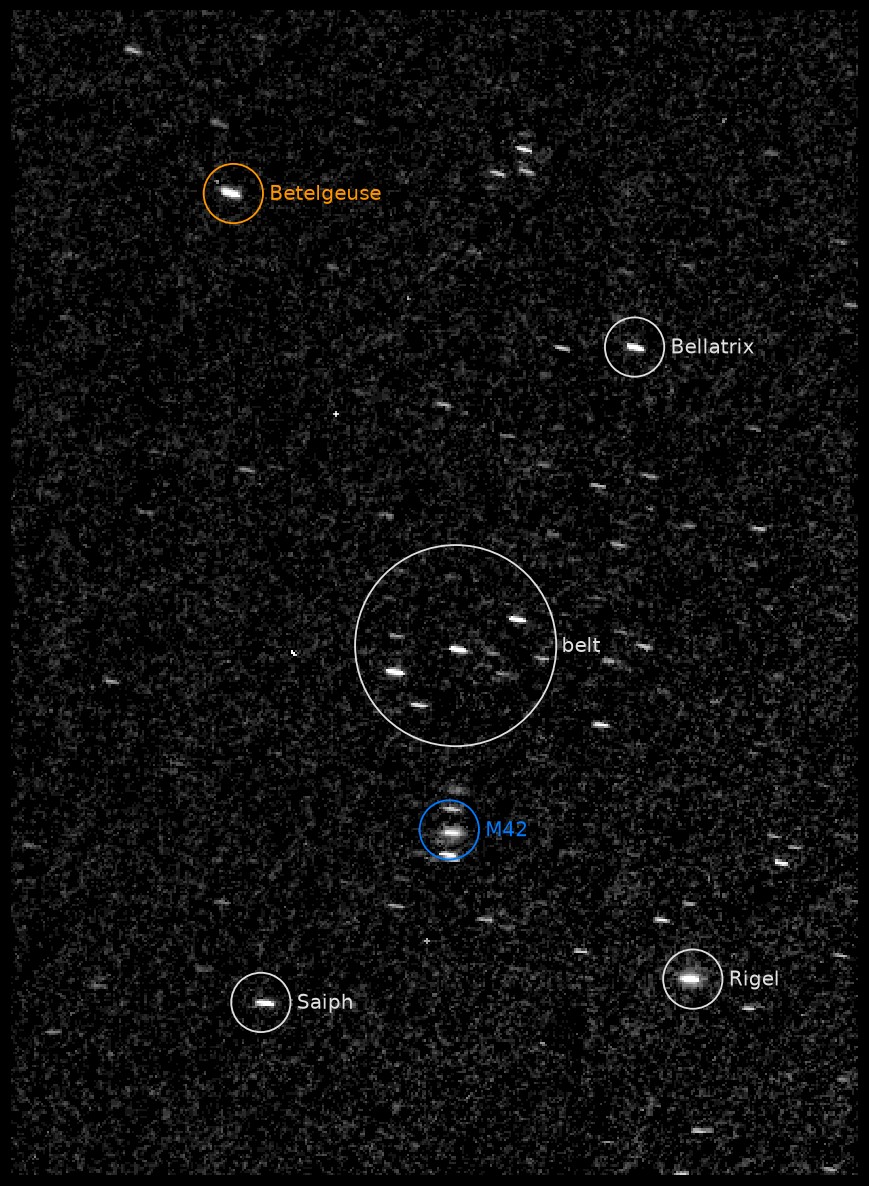
Peter: "recent screenshot has orion and M42 circled in blue. I like 1 being Betelgeuse, maybe we can detect its redness. It would be nice to see how sharp we can get M42, my first nebula." Both turn out to be visible in a camera pointed at the sky over the rooftops: Betelgeuse's colour in every frame, and a hint of the nebula after two hours of stacking.
Betelgeuse's colour
The camera sees each star through red, green and blue filters (a Bayer mosaic), so each star gives three numbers. Throughout this note a colour is written as red and blue relative to green: the three numbers are scaled so that green is 1, and only red and blue are quoted. That way a star's brightness drops out and only its colour is left.
On their own those numbers mostly describe the camera, not the star. A white star does not give equal red, green and blue: this camera's raw pixels record white as about
| red | green | blue |
|---|---|---|
| 0.33 | 1 | 0.68 |
because the sensor is most sensitive in green and a filter in front of it cuts the deep red. So a colour has to be measured against a star that is known to be white, the way a photo is white balanced: each star's red and blue are divided by the white star's, so white becomes red 1, green 1, blue 1.
Which star counts as white. The first version of this note used Rigel. Rigel is bright, but it is a hot blue-white supergiant, not white. Astronomers' white is an A-type star like Vega, so the reference is now two fainter stars in the same frames that are just that: mu Ori (type A2, magnitude 4.1) and pi2 Ori (A1, 4.4). Rigel's own raw colour is red 0.34, blue 0.72, close to theirs but a little bluer.
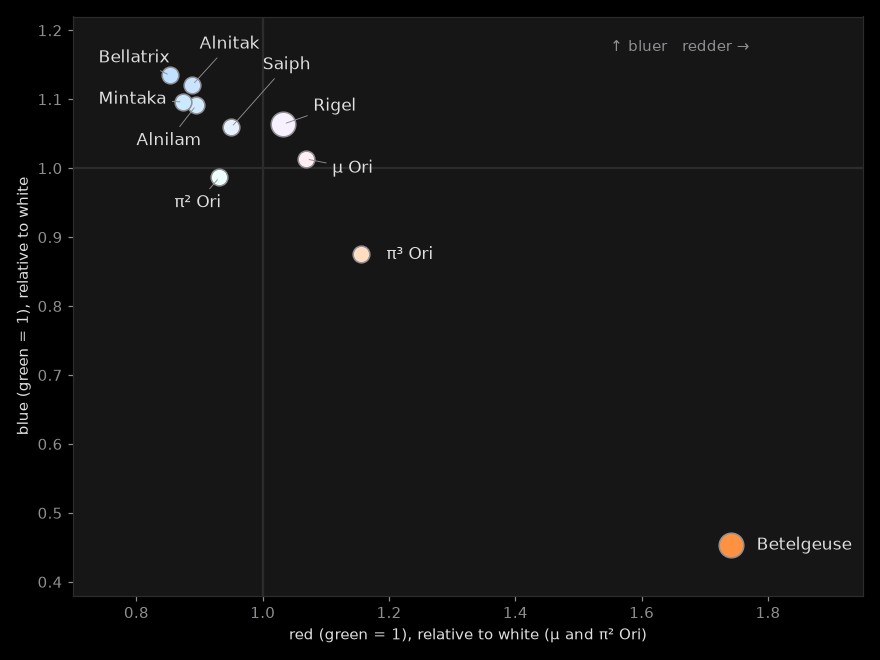
Measured over 60 frames (an hour), each star followed across the frame:
| star | type | red | blue |
|---|---|---|---|
| Mintaka | O9 | 0.87 | 1.10 |
| Bellatrix | B2 | 0.85 | 1.13 |
| Alnitak | O9.5 | 0.89 | 1.12 |
| Alnilam | B0 | 0.89 | 1.09 |
| Saiph | B0.5 | 0.95 | 1.06 |
| Rigel | B8 | 1.03 | 1.06 |
| pi2 Ori | A1 | 0.93 | 0.99 |
| mu Ori | A2 | 1.07 | 1.01 |
| pi3 Ori | F6, a little hotter than the Sun | 1.16 | 0.87 |
| Betelgeuse | M1-2 | 1.74 | 0.45 |
(Green = 1 for every star, and white is red 1, blue 1. Uncertainties about 0.02 for the bright stars, 0.05 for the faint ones.)
The hot stars come out about 10% bluer than white, the Sun-like pi3 Ori slightly yellow, and the stars fall in the same order as their catalogue colours, so the camera is measuring colour, not noise. Betelgeuse is in a different place altogether: red 1.74, blue 0.45, three quarters more red than white and less than half the blue. A simple model of a 3,600 degree star against a 12,000 degree one predicts about red 1.7, blue 0.5. It is the reddest thing in the constellation by far, and the camera sees it in every frame.
A correction: the first version of this note gave Betelgeuse's blue as 0.21 of Rigel's, from a single frame. With an hour of frames and a tighter sky measurement it is 0.43 of Rigel's (0.45 of white). The red channel, which first measured nonsense, is now as steady as the others; one frame's red was swamped by the orange sky glow.
M42
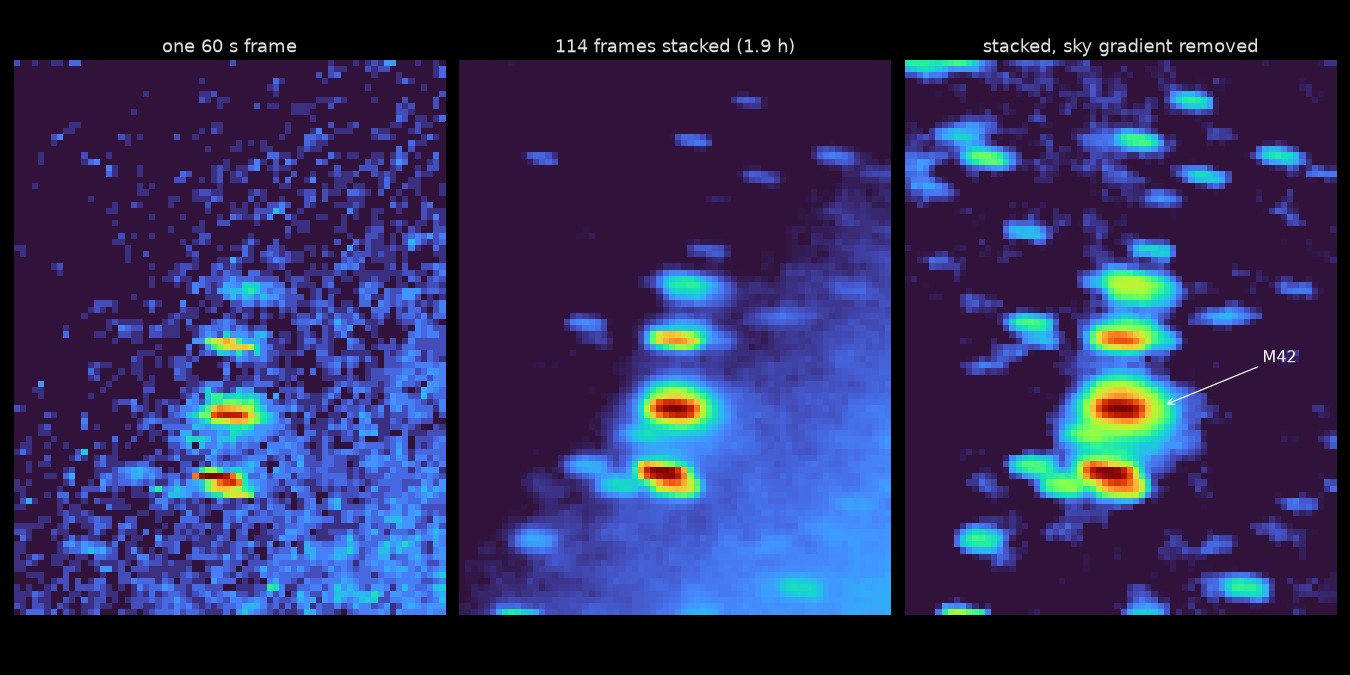
114 one-minute frames from 02:28 to 04:30 UTC, about 1.9 hours, stacked on the 03:13 frame. The camera does not track, so the sword drifts about 12 photosites a minute and the field slowly turns; each frame is aligned by matching the stars around the sword, and each colour is resampled separately. Satellite and aircraft trails drop out of a clipped mean.
In the stack the knot at M42 has a halo out to about 20 binned pixels (the stack combines each 2 x 2 RGBG set of photosites into one binned pixel), spreading down and left, which the sword stars above and below it do not have. That is the nebula's brightest part, the region around the Trapezium.
Not proven in numbers yet. The sword carries about 21% more light than its stars predict, but the same test on the belt and on empty sky is off by about 10% either way, so the sword's excess is only twice the method's error.
Nine nights, and undoing the trails
Every star is a short dash because the sky moves during each minute-long frame. The dash is the same length and direction in every frame (the camera exposes 59.9 of every 59.9 seconds), so it can be partly undone: tell a deconvolution the exact smear and it puts the light back where it came from. On one night the belt stars go from 2.7 times longer than wide to about 1.5.
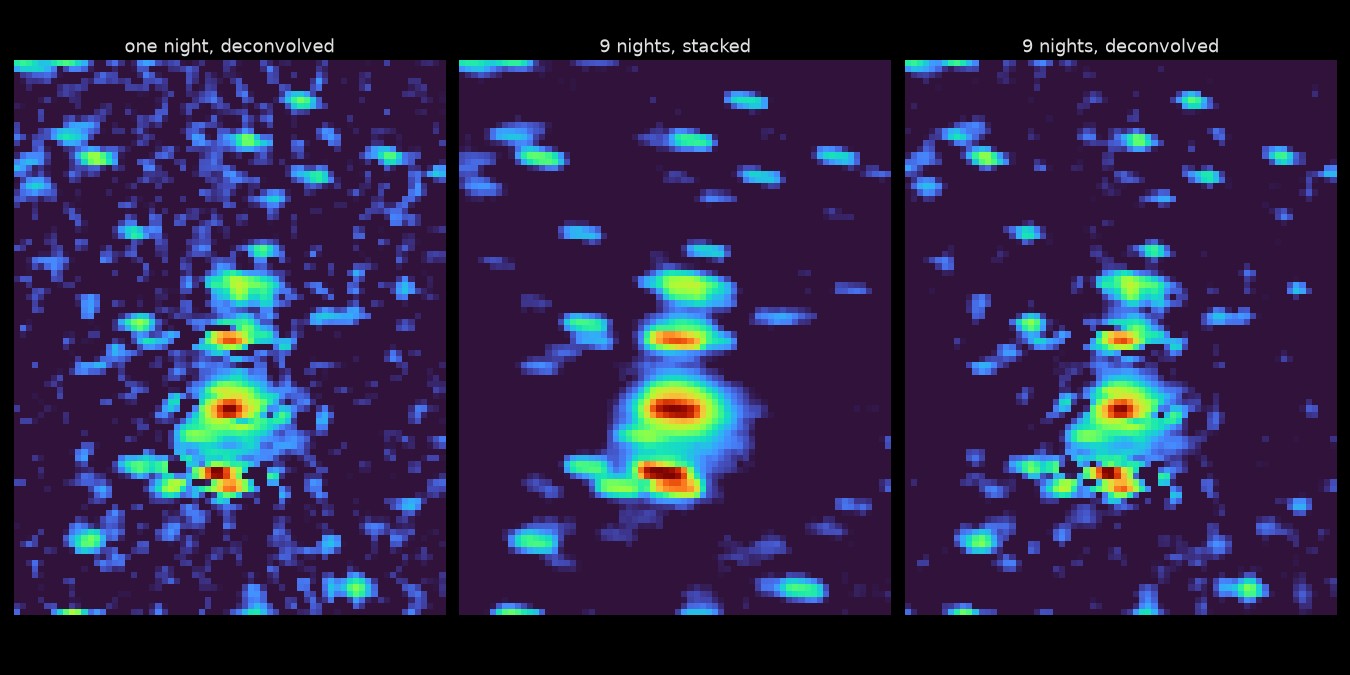
Then more nights. Orion reaches the same place in the frame about four minutes earlier each night, and nine nights between 17 September and 9 October were clear when it did: 672 frames, about 11 hours. Not every minute is equal (haze, twilight, the odd thin cloud), so each frame counts in proportion to how clearly it shows the stars, rather than all equally. That alone is worth about 13% more exposure. The nine nights together give 2.2 times the signal to noise of one night, about five good nights' worth, because several were hazy: the worst let through only a third of the starlight.
Deconvolved, the deep stack is the clearest picture of M42 so far. The stars collapse to near points and the glow around the Trapezium does not: it stays a spread-out patch, which is what a nebula should do and a star cannot.
Sharpness needed one more fix. The stars are only about one and a half binned pixels wide across the trail, too few to survive being redrawn on a new grid without smearing. The first version redrew each frame twice (onto its own night, then onto 9 October), and each redraw widened the stars by up to a quarter. Now each frame is redrawn once, straight onto the final grid, with a smoother interpolation. Across the trail the deconvolved stars went from 3.0 to 2.3 binned pixels wide, at the same depth; along the trail they stay at about 4.1, which is as far as undoing a fixed-length smear can go.
The trails can only be undone so far. The sky always smears east-west, so a fixed camera can never cross its own trails; what would help is frames of different lengths, which put the gaps in the smear in different places.
How faint
The stack also brings up stars far below what one frame shows. One faint dash just east of the sword measures magnitude 6.9 +/- 0.3 against the belt stars. Its position, from a local fit to the belt, M42 and iota Ori, is 6 arcminutes from HD 37410, a white A2 star of catalogue magnitude 6.86, and the only star that bright within half a degree. It is invisible in a single frame and a clear detection (signal to noise about 9) in 1.9 hours: just below the naked-eye limit of a dark site, from suburban London.